
UCLA research achieves first robotic-assisted cataract surgery
Dr. Uday Devgan sat at a surgical cockpit along the wall of the operating room, performing what appeared to be a routine cataract surgery. However, moments later, the former UCLA professor of ophthalmology was assisted by a surgical robot as he co-led the world's first robotic-assisted operation to address cataracts.
Devgan was joined by Dr. David Lozano Giral, an assistant clinical professor at UCLA’s David Geffen School of Medicine, in performing the breakthrough procedure – a result of more than a decade of multidisciplinary collaboration between the UCLA Samueli School of Engineering and the UCLA Stein Eye Institute. This joint effort at the intersection of medicine and engineering led to the creation of Horizon Surgical Systems.
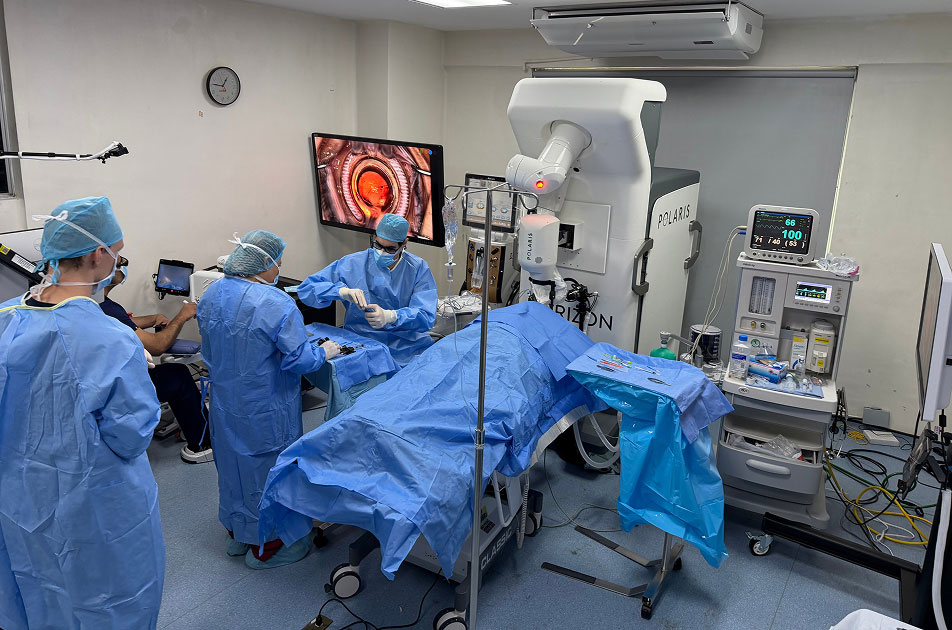
Founded by current and former UCLA faculty members, Horizon works with robotics and artificial intelligence to make eye surgery more precise, consistent and accessible.
“The professional journey of all of Horizon’s founders — from a concept sketched on a napkin to embracing the first patient who underwent the first robotic cataract procedure — was profoundly meaningful and deeply impactful,” said co-founder Jacob Rosen, a UCLA Samueli professor of mechanical and aerospace engineering and bioengineering.
Along with Rosen, fellow co-founders and UCLA professors Tsu-Chin Tsao, Dr. Jean-Pierre Hubschman and Dr. Steven Schwartz were involved with this project that addresses one of the most pressing challenges in ophthalmic surgery. Cataracts, which cloud the eye’s natural lens, affect approximately 94 million people worldwide and are the leading cause of blindness.
One of the primary difficulties in the standard cataract operation is the level of extreme precision required to operate on such small anatomical structures. To address this, Horizon developed Polaris, a robotic platform that enhances accuracy by providing real-time augmentation, guidance overlays and AI-powered 3D imaging. Surgical robotic arms then use microsurgical tools to make small corneal incisions and remove the cataract-affected lens before a surgeon implants a patient-specific artificial lens to restore vision.
In a landmark clinical study, 10 patients successfully underwent cataract surgery assisted by Polaris with no adverse events.
“This milestone demonstrates the strength of UCLA’s innovation ecosystem, where cutting-edge engineering, medical expertise and entrepreneurial support come together to improve lives,” said Amir Naiberg, associate vice chancellor and president and CEO of UCLA Technology Development Group, which licensed the technology to Horizon.
A step towards broader adoption of robotic-assisted surgery, this innovative research would not have been possible without funding in the research stage from the National Institutes of Health. As Horizon continues to refine the Polaris system and plan future clinical studies, millions of people with impaired vision can look forward to a clearer future.